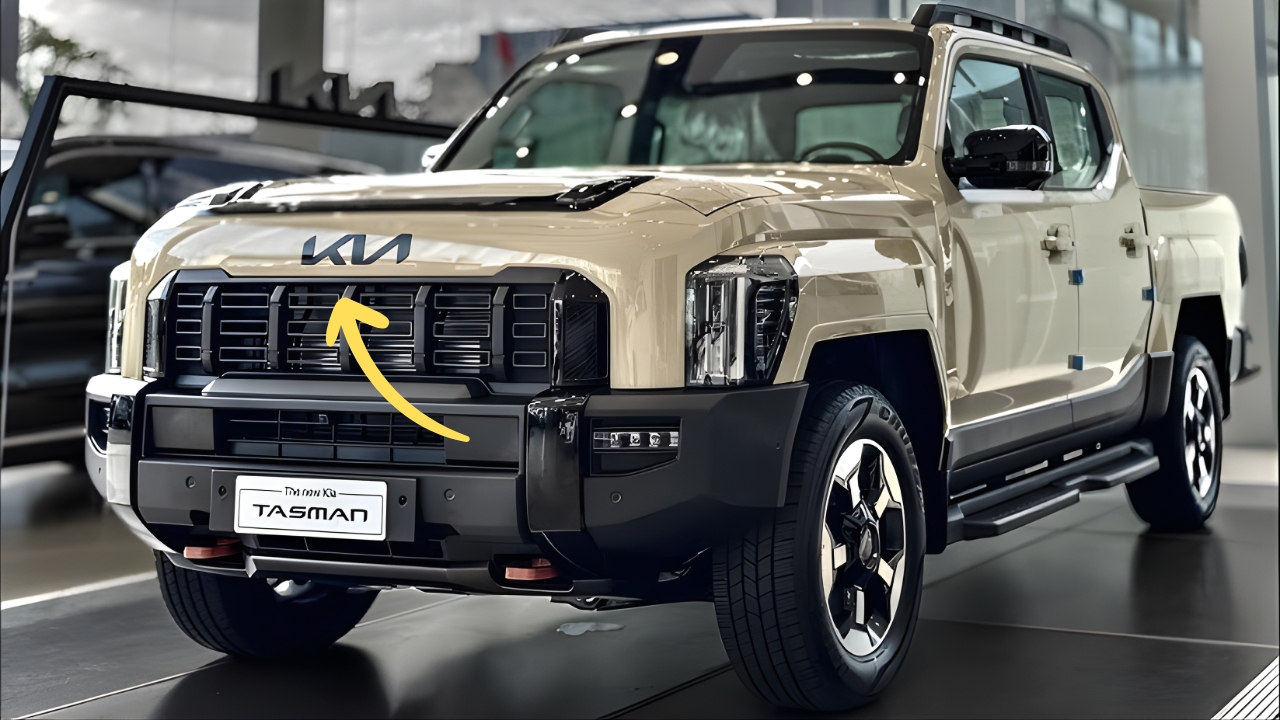
2026 Kia Tasman : The 2026 Kia Tasman is Kia’s first‑ever pickup truck, a body‑on‑frame midsize rig built to tackle work and weekend adventures with equal confidence.
Unveiled in late 2024 and hitting showrooms in Korea, Australia, Africa, and the Middle East through 2025 and 2026, the Tasman has quickly become one of the most talked‑about new trucks in global markets.
Yet for American buyers, the story is different: Kia has repeatedly stated that the Tasman itself will not be sold in the United States, even as the brand prepares a separate, U.S.‑specific midsize pickup.
What the 2026 Kia Tasman Actually Is
The Tasman sits squarely in the midsize pickup segment, slotting in length and capability between compact lifestyle trucks and full‑size workhorses.
It rides on a traditional ladder‑frame chassis with a live rear axle, underscoring its work‑truck DNA, while still offering a modern, tech‑heavy cabin that feels more like a premium SUV than a utilitarian hauler.
Outside, the truck wears bold, squared‑off styling with Telluride‑inspired headlights, a wide grille, and chunky fenders that give it a rugged, no‑nonsense presence on‑ and off‑road.
Under the hood, the Tasman launches with multiple powertrains tuned to different markets.
A 2.5‑liter turbocharged gasoline engine produces around 277–281 horsepower and roughly 311 lb‑ft of torque, paired with an eight‑speed automatic transmission.
In markets where diesel remains popular, a 2.2‑liter turbo‑diesel delivers about 207 horsepower and 325 lb‑ft, available with either an eight‑speed auto or a six‑speed manual gearbox.
All‑wheel drive is standard on higher trims, while base models can be had with rear‑wheel drive for those who don’t need constant traction.
Capability, Comfort, and Tech Inside
Despite its truck‑like bones, (2026 Kia Tasman)the Tasman’s interior leans heavily on comfort and connectivity.
A wide glass‑panel “panoramic” display spans the dash, integrating a 12.3‑inch digital instrument cluster and a 12.3‑inch touchscreen infotainment system, often accompanied by a smaller 5‑inch climate‑control screen.
Apple CarPlay and Android Auto are standard, along with dual wireless charging pads and an available Harman/Kardon audio setup, turning the cabin into a rolling command center for both work and leisure.
In terms of utility, the Tasman can tow up to about 7,700 pounds and ford around 32 inches of water, which puts it in the same ballpark as many midsize competitors.
Payload ratings vary by configuration but typically land in the 1,500–2,600‑pound range depending on bed length and drivetrain.
The truck is offered in single‑cab and crew‑cab layouts, with the higher‑end X‑Line and X‑Pro trims favoring the roomier crew‑cab and a roughly six‑foot bed, plus integrated side steps in the rear bumper for easier access to the cargo area.
Why the Tasman Isn’t Coming to the USA
For all its capability and style, Kia has made it clear that the Tasman will not be sold in the United States.
A Kia spokesperson told Edmunds that there are “no plans” to offer the Tasman in the U.S., and other outlets have received similar confirmations.
Behind the scenes, the main roadblock is the so‑called “chicken tax,” a 25 percent tariff on imported light trucks that would make a Korea‑built Tasman significantly more expensive than domestic rivals.
Kia also points to the unique demands of the American truck market, where buyers expect specific towing setups, engine options, and safety‑regulation compliance that differ from other regions.
Rather than adapt the Tasman to those rules, Kia is developing a separate midsize pickup tailored for North America, one that may share some design language or engineering ideas with the Tasman but will be a distinct model altogether.
How the Tasman Fits Into Kia’s Global Strategy
The Tasman is more than just a truck; it’s a statement that Kia is ready to compete in one of the toughest segments in the automotive world.
By launching the Tasman first in Korea and then rolling it out to Australia, Africa, and the Middle East, Kia can refine production, gather real‑world feedback, and build brand equity before tackling the even more demanding U.S. market with its own dedicated pickup.
In these markets, the Tasman is positioned as a do‑it‑all vehicle: a workhorse for tradespeople, a family hauler for weekend trips, and an off‑road‑ready rig for enthusiasts.
Trim levels such as Baseline, X‑Line, and X‑Pro allow buyers to dial in the right mix of utility, comfort, and off‑road hardware, including terrain‑management modes, locking differentials, and rugged underbody protection.
Also Read This : 2026 Lexus RX 350 Revealed high performance and luxury interior
What This Means for American Buyers
For U.S. shoppers, the 2026 Kia Tasman is essentially a “what‑if” vehicle—a glimpse of how Kia thinks about pickups without actually being on dealer lots.
While some enthusiasts have spotted Tasman‑like prototypes testing in California, those are widely believed to be engineering mules for Kia’s future American pickup, not a U.S.‑bound version of the Tasman itself.
Instead of the Tasman, American customers should expect a different midsize pickup from Kia, one engineered from the ground up for U.S. roads, regulations, and buyer expectations.
Until that model arrives, the Tasman remains a compelling footnote in Kia’s story: proof that the brand can build a serious truck, even if it’s not yet ready to bring this particular one to the world’s biggest truck market.
2026 Kia Tasman
The 2026 Kia Tasman is Kia’s bold entry into the global pickup segment, blending rugged capability, modern tech, and flexible configurations for markets outside the United States.
While American truck buyers won’t see the Tasman on local lots, its existence signals that Kia is serious about pickups and is laying the groundwork for a future U.S.‑oriented model.
For now, the Tasman stands as a capable, tech‑savvy midsize truck that’s capturing attention abroad—leaving U.S. fans to watch closely for what Kia’s first American pickup will look like when it finally arrives.